A dog pulling on leash happens for one simple reason: it works.
Understanding this is the key to stopping it. Your dog isn't being stubborn or defiant. They're following basic learning principles.
Most dogs keep dog pulling on leash because they haven't learned that calm walking works better.
The good news: dogs learn this quickly. Most dogs show improvement within the first week of consistent training. Some take longer, but the pattern is always the same.
Choosing the Right Equipment: No-Pull Harness for Dogs
The right harness makes training easier and keeps your dog safe. A no-pull harness for dogs redirects your dog's forward motion when they pull, making the behavior less rewarding without causing pain or discomfort.
Not all harnesses work the same way. The design matters. A standard back-clip harness gives your dog more pulling power. A front-clip harness redirects their body and slows them down. If you're serious about stopping pulling, the front-clip design is where most trainers start.
Front-Clip vs. Back-Clip Harnesses
A front-clip harness has the leash attachment point on the dog's chest. When your dog pulls, the harness gently turns them toward you instead of letting them lunge forward. This isn't painful.
A back-clip harness attaches the leash at the shoulder blades. This design gives your dog more pulling power and is better for dogs who already walk calmly.
For most dogs learning to walk on a loose leash, front-clip is the better choice.
Harness Fit and Safety
A harness that doesn't fit properly won't work and can hurt your dog. Measure your dog's chest and neck before ordering. Most harnesses come with sizing guides. Use them.
Check the fit by sliding two fingers under the straps. You should feel slight resistance but not tightness. Your dog should move freely without the harness shifting or riding up.
Look for padded harnesses or ones made from soft materials. At furfamilymarket, we carry harness options like the Ancient Pottery Velvet Set and Black Velvet Set, which combine personalized design with adjustable fit for small, medium, and large dogs.
Training your dog to walk on a loose leash takes time and consistency, but the process is straightforward. Follow these steps in order. Skip steps and you'll create confusion. Stick with each step until your dog shows progress before moving forward.
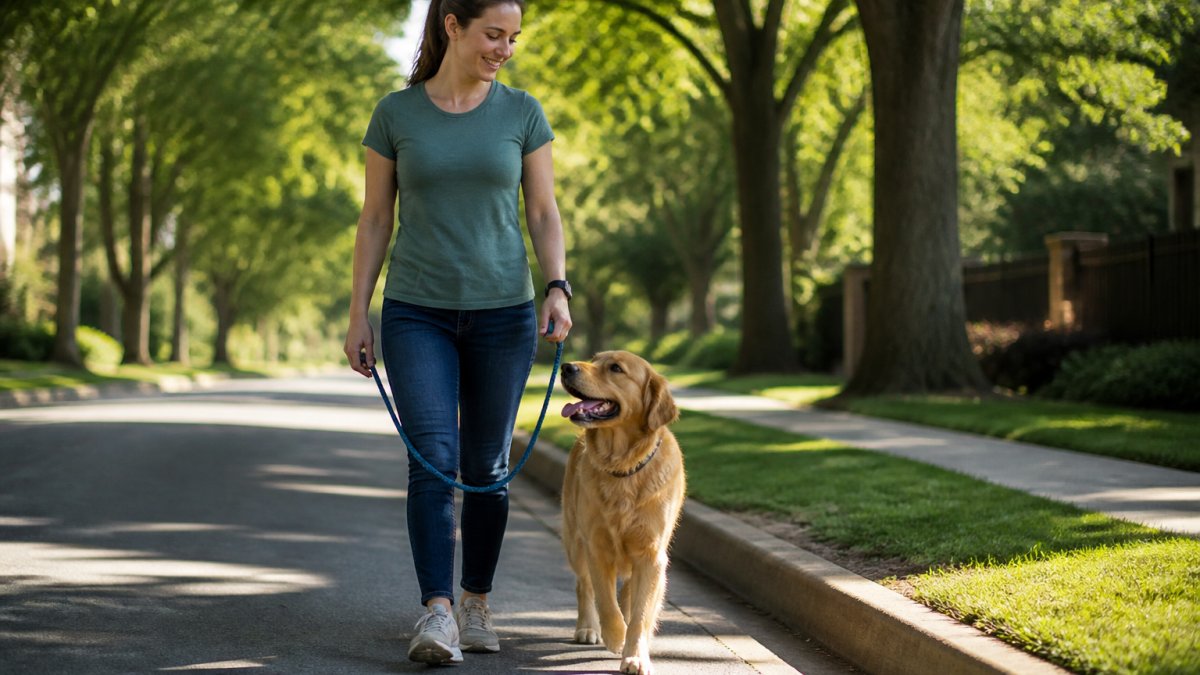
Dog owner walking a golden retriever on a leash with slack tension, dog calmly positioned beside handler on a tree-lined neighborhood street with natural morning light
Step 1: Calm Behavior Before Leaving Home
Start your training before you leave the house. A dog that's excited at the door will be excited on the walk. Teach calm behavior first.
Before putting on the leash, wait for your dog to sit or stand quietly. Don't clip the leash while they're jumping or pulling at the door. This rewards the wrong behavior. Wait.
Repeat this every single time you prepare for a walk. It takes an extra 30 seconds. Your dog learns that calm behavior opens the door, not excitement.
Step 2: Get Your Dog's Attention
Your dog can't walk calmly if they're focused on everything except you. Before you step outside, teach them to look at you on command.
Use a word like "watch" or "focus." Hold a treat near your face. When your dog looks at you, say the word and immediately give the treat. Practice this indoors first.
Once your dog reliably looks at you indoors, practice on walks. The Pet Dog Training Treat Pouch keeps treats at your waist for quick access without fumbling in pockets.
Pet Dog Training Treat Pouch – Puppy Snack Reward Waist Bag for Obedience & Agility Training
Step 3: Reward Loose-Leash Walking
Every time your dog walks beside you with slack in the leash, reward them. Use treats, praise, or a toy. Make calm walking more rewarding than pulling.
Walk for 10 steps. If the leash stays loose, give a treat. Walk another 10 steps. Reward again. Gradually increase the distance between rewards.
Be generous with rewards early. You're building a new habit. Your dog needs to understand that this behavior works. Stingy rewards won't create the connection fast enough.
Step 4: Stop Walking When Your Dog Pulls
The moment your dog pulls, stop moving. Don't yank back. Don't scold. Just stop. Stand still like a tree.
Your dog will pull harder at first. Ignore it. Wait for the leash to go slack. The moment it does, move forward again. Your dog learns: pulling makes us stop. Slack leash makes us move.
This step takes patience. Some dogs test this for weeks. They'll pull, you'll stop, they'll pull again. Stay consistent. Eventually, they realize pulling doesn't work.
Step 5: Stand Firm and Wait for Slack
When your dog pulls, don't move backward or sideways. Plant your feet and wait. Your dog will eventually look back, sniff around, or relax. The moment the leash goes slack, move forward.
This teaches your dog that pulling stops progress. Only loose-leash walking moves the walk forward. It's simple cause and effect. Dogs understand this quickly.
Step 6: Practice in Low-Distraction Areas
Start training in quiet places. Your backyard, an empty parking lot, or a quiet street works. Your dog has fewer things to pull toward, so they can focus on you.
Once your dog walks calmly in low-distraction areas for several days, gradually introduce more stimuli. Walk near a park. Pass other dogs at a distance. Slowly increase difficulty as your dog improves.
Training in chaos from day one sets you up for failure. Build the foundation in calm environments first.
Step 7: Gradually Increase Difficulty
As your dog improves, add challenges. Walk past other dogs. Visit busier areas. Let your dog explore more while maintaining loose-leash walking.
This is where many people make mistakes. They rush to the hardest situations too fast. Your dog isn't ready, pulling returns, and people think training failed. It didn't. They just skipped steps.
Move slowly through this progression. Spend at least a week at each difficulty level before advancing. Your dog will let you know when they're ready. If pulling increases, you moved too fast.
How Long to Train a Dog Not to Pull
Most dogs show noticeable improvement within one to two weeks of consistent training. Some progress faster. Others take three to four weeks.
Strong adult dogs that have pulled for years take longer than puppies just learning the rules.
Consistency matters more than duration. Training five minutes every single day produces faster results than one long session per week. Short, frequent practice builds habits.
Expect steady progress, not sudden transformation. Week one: your dog pulls less in low-distraction areas. Week two: they walk calmly in familiar places.
Troubleshooting by Cause and Context
Training doesn't always go smoothly. When progress stalls, look at the cause. Different problems need different solutions.
When Your Dog Lunges at Other Dogs or People
Lunging is different from regular pulling. Your dog has fixated on something and is pulling hard toward it. This needs a specific approach.
First, increase distance. If your dog lunges when another dog is 20 feet away, practice at 50 feet.
Second, redirect attention before lunging happens. When you see another dog approaching, get your dog's attention before they notice.
Third, don't let your dog practice lunging. Every time they lunge successfully, they learn it works. Avoid situations where lunging happens until training improves.
Training Puppies vs. Adult Dogs vs. Strong Breeds
Puppies learn fast but lack impulse control. They pull because they're excited about everything. Training works, but expect frequent regression. Puppies have good days and bad days. Stay patient.
Adult dogs that have pulled for years have established habits. They learn they can pull and get results. Retraining takes longer because you're breaking an old pattern and building a new one.
Strong breeds like pit bulls, German shepherds, and golden retrievers have the physical power to pull hard. They need front-clip harnesses and consistent training more than smaller dogs.
When to Seek Professional Help
If your dog shows signs of aggression when pulling, lunging, snapping, or growling at other dogs or people, get professional help. This is beyond basic loose-leash training.
If your dog hasn't improved after four weeks of consistent training, a trainer can identify what you're missing. Sometimes small adjustments in technique make the difference. Sometimes your dog needs a different approach.
If you're injured during training or feel unsafe, stop and get help. A trainer can teach you safer techniques and help your dog learn faster.
Common Mistakes to Avoid
Pulling back on the leash. This teaches your dog to pull harder.
Rewarding pulling by moving forward. If your dog pulls and you keep walking, you've rewarded pulling.
Inconsistent training. If you enforce loose-leash walking sometimes but not others, your dog gets confused.
Training only during walks. Practice the "watch" command indoors. Practice calm behavior at the door.
Skipping steps in the plan. Each step builds on the previous one. Skipping ahead creates confusion.
Expecting perfection too fast. Your dog is learning a new skill. Progress isn't linear.
Measuring Progress and Setting Realistic Expectations
Track progress by counting pulling incidents per walk. Week one: your dog pulls 20 times. Week two: 15 times. Week three: 10 times. This downward trend shows improvement.
Also notice the intensity of pulls. Early pulls are hard and desperate. As training progresses, pulls become softer and shorter. Your dog is testing the boundaries less aggressively.
Set realistic expectations for your specific dog. A five-year-old strong breed won't walk as calmly as a calm two-year-old small dog. That doesn't mean training failed.
A successful outcome isn't perfection.
Frequently Asked Questions
Why does my dog pull so much on the leash?
Dogs pull for several reasons: excitement about their surroundings, lack of training, insufficient exercise, or a desire to explore. Puppies and high-energy breeds pull more naturally. Pulling also gets rewarded unintentionally when owners move forward during a pull, teaching dogs that pulling works. Understanding your dog's specific trigger, whether it's other dogs, people, smells, or just the thrill of the walk, helps you address the root cause rather than just the symptom.
How long does it take to train a dog not to pull on the leash?
Most dogs show noticeable improvement within 1-2 weeks of consistent training using positive reinforcement and a no-pull harness. Puppies often learn faster than adult dogs. However, full habit change typically takes 4-8 weeks of daily practice. Strong breeds and dogs with established pulling habits may need 8-12 weeks. Consistency matters more than speed, even 15-minute daily sessions outperform sporadic longer sessions. Progress isn't always linear; expect plateaus and setbacks.
Do no-pull harnesses actually stop dogs from pulling?
No-pull harnesses reduce pulling force and make pulling less rewarding, but they don't stop pulling on their own. A front-clip harness gently turns your dog's body toward you when they pull, discouraging forward momentum. Combined with training, rewarding loose-leash walking and stopping when your dog pulls, a no-pull harness is highly effective. The WUNDERleash, for example, uses a shock-absorbing rubber core to reduce pulling power by up to 50% while your dog learns correct behavior. Harnesses work best alongside consistent training, not as a standalone fix.
Should I stop walking when my dog pulls?
Yes. Stopping walking when your dog pulls is one of the most effective training tools. It teaches your dog that pulling doesn't get them forward, only loose-leash walking does. When your dog pulls, stand firm and wait for slack in the leash (this may take 30 seconds to a few minutes at first). The moment there's slack, reward with treats or praise and resume walking. This creates a clear cause-and-effect: pulling pauses progress, loose leash means forward movement. Consistency is essential; every family member must follow the same rule.
Training your dog to stop pulling on the leash is one of the most rewarding skills you can teach. A calm walk makes daily life easier and safer for everyone. At furfamilymarket, we understand that quality equipment and the right tools make training faster and more enjoyable. Start with a well-fitting front-clip harness, use high-value treats, and follow this step-by-step plan with consistency. Your dog can learn to walk calmly beside you, and you'll both enjoy your time together more.