Walk into any pet store and you'll see shelves packed with bright packaging and bold claims. When every brand says it offers the best for your pet, the words stop meaning anything.
Quality matters because your pet can't tell you when something is wrong.
Here's the good news: quality leaves clues. Better materials, clearer labels, sturdier construction, and honest sourcing all show up when you know where to look.
Pet Product Safety Standards You Can Actually Verify
Verification starts with a simple question: who tested this, and can I see proof? A manufacturer that answers that clearly is usually worth trusting. Most shoppers don't know which standards exist, which labels are independently audited, or where to look up a claim.
The Standards That Actually Exist
Safety standards for pet products vary by country and by product category. A few well-known public frameworks are worth knowing:
ASTM International publishes voluntary consensus standards for many consumer products, including pet toys and feeding items. A manufacturer citing a specific ASTM standard number (for example, a toy safety standard) is giving you something checkable.
ISO standards cover materials, manufacturing processes, and testing methods used across consumer goods. An ISO reference on a label should point to a specific standard number, not just the letters.
FDA regulates pet food and some animal health products in the United States. Pet food labels must follow FDA labeling rules, and the agency publishes recall notices.
USDA oversees certain animal products and pet food ingredients tied to meat and poultry inspection.
Consumer Product Safety Commission (CPSC) handles recalls for many consumer goods, including some pet products, and maintains a public recall database.
State-level feed control officials (through AAFCO-affiliated programs) set nutritional standards for pet food sold in the U.S.
None of these guarantee a product is good. They tell you what was checked and against what benchmark. A product with no standard reference is unverified.
Certifications and Labels That Carry Weight
Not all labels are equal. Some are earned through independent audits; some are just artwork. The meaningful ones come from recognized testing bodies and require ongoing compliance.
A practical way to sort labels:
Named certifying body. The label should identify who issued it. "Third-party tested" with no issuer is not a certification.
Standard number. A real certification usually references the standard it tests against (an ASTM, ISO, or equivalent number).
Scope. The certification should cover the product category you are buying. A toy safety certificate does not vouch for a food bowl.
Current status. Certifications expire or get suspended. The issuer's website should let you confirm the product is still listed.
Treat any label you don't recognize as a question, not a promise. Search the certifying body's name and confirm it exists and tests the product category you're buying. If the only result is the brand's own marketing page, that's a signal.
Pro TipBefore buying, ask the seller for the safety documentation and the name of the testing lab. A serious supplier will send it without hesitation. A seller who dodges the question has told you everything you need to know.
How to Verify a Safety Claim in Five Minutes
You don't need a lab to sanity-check a claim. Use this sequence:
Search the standard number. If the label cites ASTM F963 or an ISO number, search that exact string plus the product type. You should find the standard's scope and what it covers.
Search the certifying body. Confirm it is a real organization with a public website and a way to look up certified products.
Check recall databases. In the U.S., the CPSC recall database and FDA recall pages are public. Search the brand and product name.
Look for batch or lot numbers. A manufacturer that prints lot codes can trace and recall specific batches. No lot code means no traceability.
Read the material disclosure. Exact grades and named materials are checkable. Vague terms like "premium blend" are not.
A claim you can trace to a named standard and issuer is worth more than any badge on the box. A claim you can't trace is marketing.
What Compliance Does and Does Not Tell You
Compliance is a floor, not a ceiling. A product can meet a minimum safety standard and still be poorly made or short-lived. Use compliance as a gate: if a product can't show any verifiable standard or testing reference, keep looking. If it can, move on to the durability and materials checks.
How to Read Pet Product Labels Without Getting Fooled
Reading a pet product label is a skill, and most shoppers skip the two parts that matter most: the ingredient or material list and the manufacturer details.
Start with these steps:
Find the full ingredient or material list. If it's hidden or missing, move on.
Check the order. Ingredients are listed by weight, so the first few items tell you the most.
Look for named sources. "Chicken" beats "meat meal." "Stainless steel, grade 201" beats "metal."
Locate the manufacturer name and country of origin.
Scan for contact details. Real makers want to hear from you.
Marketing words like "natural," "premium," or "vet-approved" carry little legal weight in most places. They're chosen to sound reassuring, not to prove anything.
Jeffers Standard-Weight Stainless Steel Food & Water Pet Bowls
Materials, Durability, and What They Mean for Your Pet
Material choice drives safety, comfort, lifespan, and ease of cleaning. Cheap material fails early, often in ways your pet notices first. What follows is a product-by-product way to judge durability and compare price against how long a product actually lasts.
A Product-by-Product Durability Framework
Different categories fail in different ways.
Food and water bowls. The failure mode is surface degradation and bacterial buildup.
Toys. The failure mode is breakage that creates a swallow hazard.
Beds. The failure mode is foam compression and seam failure.
Collars, harnesses, and leashes. The failure mode is hardware failure under load.
Grooming tools. The failure mode is dulling and corrosion.
Seams: hidden, reinforced seams survive chewing better than loose stitching
Frames: solid hardwood outlasts particleboard by years
Liners: waterproof layers protect foam cores from accidents
Hardware: rust-resistant fittings keep working after repeated washing
Repairability: replaceable covers, blades, and parts extend lifespan far beyond a sealed unit
A product that lasts three times as long usually costs less per year than the bargain version you replace twice. That total-cost-of-ownership view is the most useful durability test you can run before buying.
Total Cost of Ownership: Price per Year of Use
Compare purchase price against expected lifespan, replacement frequency, repairability, and warranty coverage:
Price per year = purchase price ÷ expected years of use
A bed that costs more but holds its shape for five years can beat a cheaper bed replaced every eighteen months. The same logic applies to leashes, bowls, and grooming tools.
Key TakeawayJudge durability by the failure mode for that product category, then divide price by expected years of use. The cheaper unit is often the more expensive one over time.
Your Pet Product Quality Checklist for Smarter Buying
Run every product through the same short checklist before it goes in your cart. It takes two minutes and saves months of regret.
Full material or ingredient list is visible
Manufacturer name, country, and contact details are stated
Safety testing or certification is named and verifiable
Construction feels solid: no loose parts, sharp edges, or weak seams
Cleaning instructions are realistic for your routine
Size and weight limits match your pet
Return policy covers damage or rejection by your pet
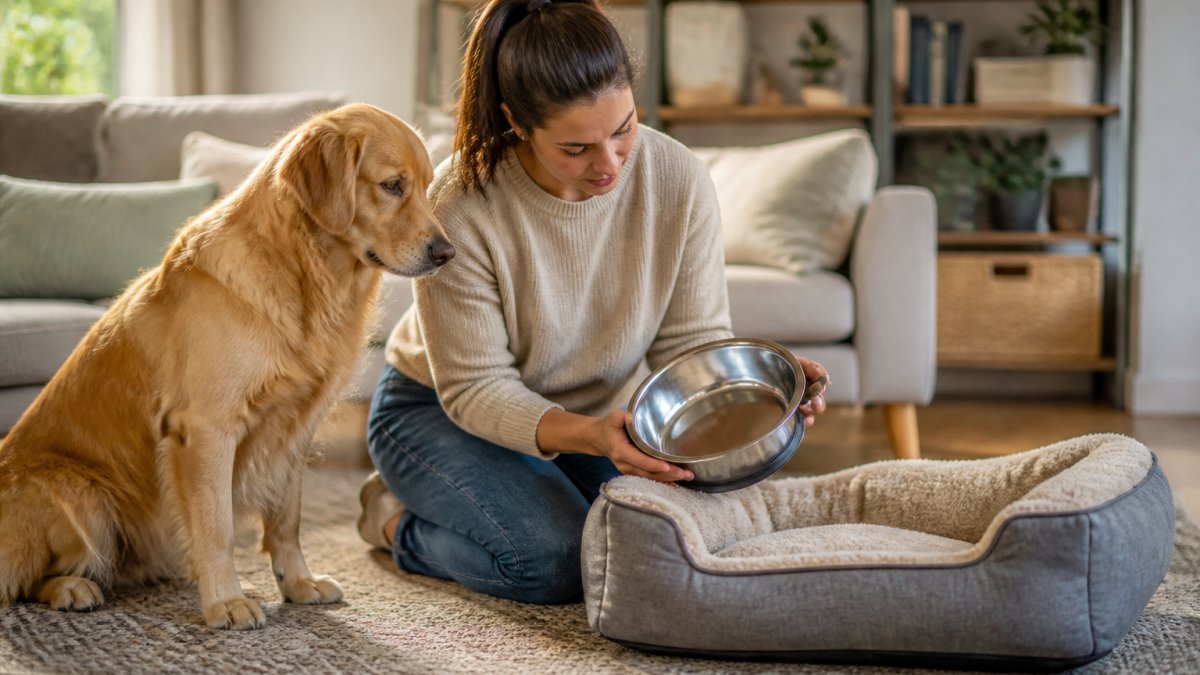
A pet owner kneeling on a living room floor examining a stainless steel pet bowl and a plush dog bed, with a golden retriever watching closely in warm natural light
Watch OutThe most common mistake is buying on looks alone. A bed with a beautiful cover and a weak foam core collapses within months, and your dog pays the price in joint discomfort. Check what's inside, not just what's on top.
Red Flags and Misleading Marketing Claims
Some warning signs repeat across the industry:
Vague claims like "vet-formulated" with no named veterinarian or lab
Photos of testing that show no actual equipment or results
Prices far below the material cost of what's advertised
No physical address or working contact channel
Reviews that all appeared in the same week
If a listing hides its materials, its maker, or its testing, that silence is the answer.
Finding the Best Orthopedic Dog Bed for Large Dogs
Large dogs need more than a bigger cushion. Their weight compresses cheap foam fast, so support and structural strength matter most.
Look for these features:
High-density memory foam that recovers its shape instead of flattening
A solid frame that won't bow under weight
A waterproof liner protecting the foam from accidents
A washable cover that survives frequent cleaning
A stated weight limit that fits your dog
Our Haven orthopedic dog bed is built around exactly these points: a solid hardwood frame, an orthopedic memory foam mattress with a waterproof liner, a machine-washable cover, and a 10-year structural warranty.
Luxury Handcrafted Solid Wood Orthopedic Waterproof Dog Bed Haven
For lighter dogs or multi-pet homes, the HuggleFleece Mat offers a stuffing-free design with hidden seams and machine-washable fabric. It suits dogs that chew and cats that need a soft, portable spot.
HuggleFleece® Mat Cat & Dog Bed
Feature
Haven Orthopedic Bed
HuggleFleece Mat
Best for
Large dogs up to ~55 lbs
All sizes, chewers, cats
Core
Orthopedic memory foam
Dense synthetic fleece
Frame
Solid hardwood
None, flexible mat
Waterproof
Yes, lined mattress
No
Washing
Removable cover
Whole mat machine washable
Warranty
10-year structural
Not stated
Best ForSenior dogs and large breeds that need firm joint support and a bed that holds its shape for years.
Matching Quality to Your Pet's Age, Size, and Health
The same product can be right for one pet and wrong for another.
Puppies and kittens chew everything. Choose hidden seams, no loose stuffing, and washable fabrics.
Adult pets need durable daily-use items. Prioritize materials that resist odor and hold shape.
Multi-pet homes should favor easy-clean surfaces and products with clear size limits.
One more factor: check for product recalls after purchase.
Frequently Asked Questions
What makes a pet product high quality?
High-quality pet products combine safe, non-toxic materials with construction that holds up to daily use. Look for clear material composition, transparent sourcing, and quality control standards the brand is willing to explain. A stainless steel bowl, for example, should state its grade and be dishwasher safe. Durability, comfort, and how well the product fits your pet's size and needs all matter as much as the price tag.
How can I tell if a pet product is safe for my pet?
Start with the label: check for non-toxic materials, a full ingredient or material list, and any safety testing claims. Verify certifications rather than trusting a badge graphic. Avoid products with vague claims like 'pet safe' and no supporting detail. For chews and toys, match the size to your pet to prevent choking. If a product has no contact information or sourcing details, treat that as a warning sign.
Are expensive pet products always better quality?
No. Price often reflects branding, marketing, and retail markup rather than materials alone. A $360 handcrafted solid wood orthopedic bed with a 10-year structural warranty justifies its cost through joinery-crafted hardwood and pressure-relieving memory foam. A $2 stainless steel bowl can still be excellent if the steel grade and non-porous finish are right. Judge quality by materials, construction, and verifiable claims, not price alone.
How do I know whether a pet product will last?
Check the construction details: solid hardwood versus particleboard, hidden seams versus exposed stitching, rust-resistant stainless steel versus coated metal. Look for a stated warranty, which signals the maker's confidence. Read reviews that mention months of use, not just first impressions. For beds, a machine-washable cover and waterproof liner extend lifespan significantly. Total cost of ownership favors products that survive daily wear.
Quality in pet products comes down to proof: named materials, verifiable testing, solid construction, and a maker willing to stand behind the work. It takes effort to check, and that's exactly why so many shoppers skip it. At furfamilymarket, we do that checking for you, with exclusive picks chosen by pet lovers, fast delivery to your door, and quality products you can count on. Search our collection and give your companion the comfort and security they deserve.